Avocado irrigation: drip, fertigation and frost protection
Avocado is sensitive to soil water, nutrition and frost. Three systems work together: drip irrigation, fertigation with pH and conductivity probes, and frost-protection sprinklers over the canopy.
Avocado is now a fruit of high economic interest, and worldwide consumption has grown strongly in recent years. Rich in healthy fats, vitamins and minerals, its rising consumption is most noticeable among younger age groups.
That growth has driven new plantings, and Portugal stands out as a country with high productive potential, thanks to excellent soil and climate conditions for this crop, especially in the Algarve and on the Vicentine coast. It is a crop that is very sensitive to soil water balance and nutrition, and particularly vulnerable to frost.
Three systems
Avocado irrigation aims to meet the crop's water needs, so that it gets close to its maximum productive potential.
Built into the irrigation system, fertigation is especially important for dosing fertilisers into the irrigation water efficiently, working together with pH and electrical conductivity probes.
The frost-protection system defends the plants when frost forms: it is a sprinkler system over the treetops.
Drip irrigation
Avocados are irrigated by localised (drip) irrigation. Drip irrigation delivers water efficiently, creating favourable conditions close to the roots with little loss through evaporation and infiltration.
Two dripline rows are usually laid per crop row. Dripper flow and spacing depend on the soil, the varieties and the agronomic management; the most common are spacings between 30 and 75 cm and flow rates between 0.7 and 2.2 L/h.
Fertigation
In the fertigation system, a set of dosing pumps draws fertilisers from the tanks and injects them into the pipeline. This makes it possible to dose precise amounts of fertiliser into the water at the right times, efficiently.
Fertiliser injection can be coordinated with a set of pH and conductivity probes. The irrigation controller monitors and corrects the parameters, telling the system to inject more or less fertiliser when needed.
Frost protection
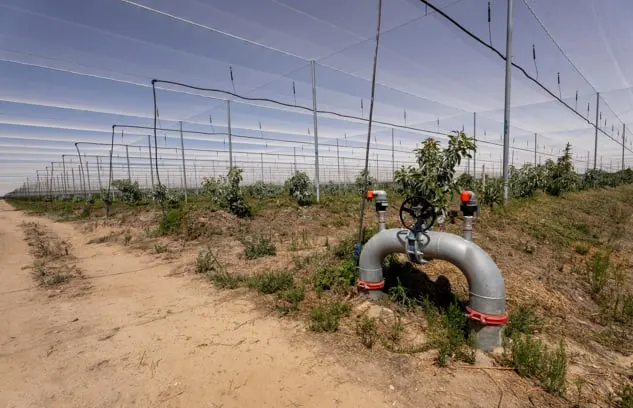
The frost-protection system runs in parallel with the irrigation system. For effective protection, sprinklers are used over the canopy to stop ice crystals from forming. The system should switch on automatically as soon as the temperature falls below a set value, measured by temperature probes connected to the irrigation controller.
This sprinkler system must be able to protect the whole area at risk of frost and, to be effective, should deliver close to 2 mm/h.
One system, sized as a whole
Avocado is particularly sensitive to soil water, fertilisation and frost. To get the most from the crop, it needs an irrigation system that handles all three, so that none of them becomes a limiting factor.
Correct sizing is essential: the system must meet the crop's water needs, dose fertilisers in a controlled way and protect the plants from frost. See how Magos installed avocado irrigation in Grândola, for Azul Empírico, and in Montargil, for Atlantrees, where the crop relied on a frost-protection sprinkler system.