Irrigating vineyards in the Douro: from pumping to dripper
How vineyards are irrigated on the Douro terraces: water pumped from the river to a storage tank and gravity irrigation, mesh filtration, protection valves and pressure-compensating drippers.
The Douro is the oldest demarcated and regulated wine region in the world: it was demarcated in 1756 by the Marquis of Pombal, and in 2001 the Alto Douro Wine Region was listed by UNESCO as a World Heritage Site.
The soils are mainly anthrosols, deeply shaped by people on vineyard land, on a schist base with granite formations. The climate is mainly continental, with cold, rainy winters and hot, dry summers.
Terraces and vertical planting
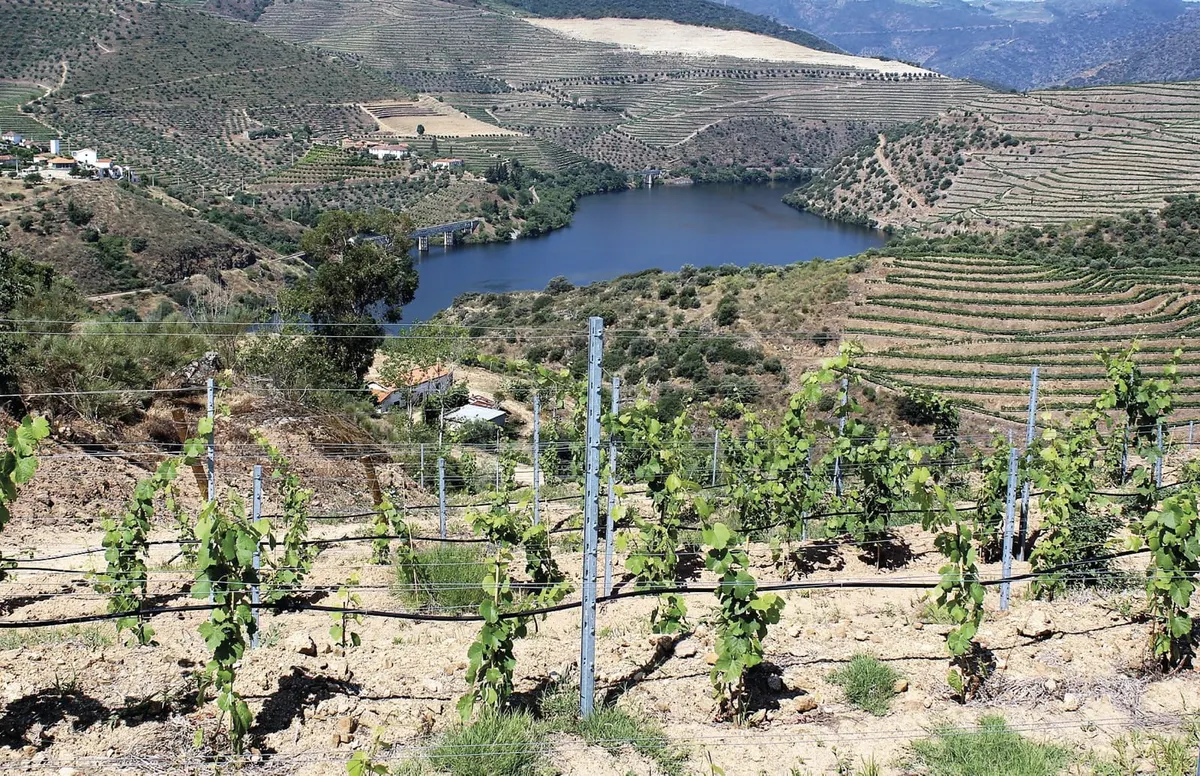
The close relationship between human work and nature created a unique ecosystem, where the land was turned into terraces that protect the soil from erosion and allow vines to be grown. New vineyards were planted on terraces with one or two rows, or "vertically" up the slope, to make mechanisation easier and the work less demanding.
Why irrigate vineyards in the Douro
Although vineyards are not traditionally irrigated in this region, several studies show that water shortage in some soil and climate conditions, such as sloping, very permeable and dry soils, affects the quality and yield of the vineyard. That is why irrigation is increasingly used.
Gravity irrigation or pumping
In the Douro, the steep slopes make gravity irrigation possible. To save energy, water is pumped from the river to a storage tank, from which irrigation runs with no energy cost. Where the difference in height does not allow it, conventional pumping is the solution.
Filtration and pipes
Filtration is very important to stop particles that could clog the drippers, and it must suit the type of water; mesh filtration is the most common. The filter must be placed where the working pressure is respected, so that it works properly.
The pipes are polyethylene, a material that withstands the region's stony soil. The pipes' nominal pressure must be chosen for each project.
Protecting the system
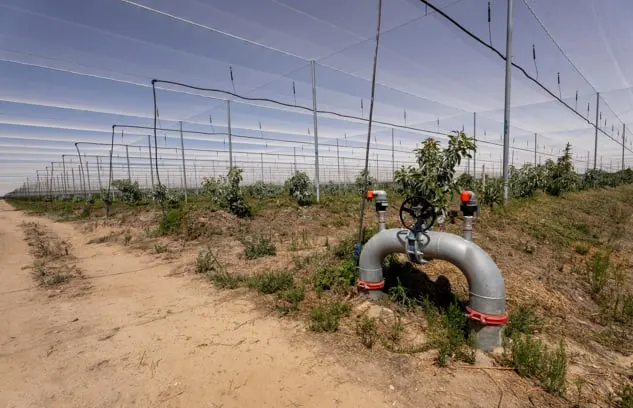
To protect the irrigation components, air valves are fitted along the pipes, letting air in and out and preventing them from collapsing, together with check valves that prevent water hammer when pumping stops (when filling tanks installed higher up). Pressure-reducing valves are also fitted, so that the excess pressure coming down the slope does not damage the system or make it hard to regulate pressure in the irrigation sectors.
Pressure-compensating drippers
Drip irrigation is the most suitable for vineyards, and pressure-compensating drippers should be chosen: they deliver the same flow across the working pressure range, ensuring even water distribution along the line.
The most common spacing between drippers is 0.5 m, with a flow rate of 1.6 L/h. The distance between drippers must supply enough water to create a wetted strip suited to root development.
Sizing the laterals is very important in these installations, because the pressure needed at the start of the line determines the pressure across the whole sector. Since the entire sector must be within the pipe's working range, choosing the right diameter is essential.
Watering at planting and maintenance
Watering vines at planting has proved decisive for good rooting. Although water availability in the region is not very high, irrigation gives growers considerable increases in yield.
Success depends on an irrigation system that is well sized, well installed and fitted with the right protection and control equipment, together with proper maintenance. That is what lets growers get the most out of their investment.
References
- [1]Drip irrigation system
- [2]Filtration
- [3]Valves
- [4]Pumping
- [5]Water storage